
Lessons From Testing Navigational Career Support With Workforce Partners
Published July 2026
Executive Summary
When this work began, the hypothesis was focused: landing a job is not the finish line. Workers who complete workforce programs and secure employment continue to face high-stakes moments, a difficult manager, a role that isn't working, a layoff that arrives without warning—and those moments are largely unaddressed by the systems that helped them get there. Navigational support delivered at exactly those points, in close partnership with the workforce organizations with the deepest roots in their community, could extend the impact of training and produce outcomes that hold. Workforce programs deliver transformative value. But the space between placement and stability has historically been where workers are left on their own. That gap, we believed, represented an opportunity for outsized impact.

What eighteen months of testing revealed is that the hypothesis was right, but the aperture was too narrow. The need is not confined to alumni. It is not confined to a single organization, a single program, or a single moment in a worker's journey. Workers move between jobs, programs, and organizations more frequently than ever, and the support structures around them have not kept up. The gap is not just between program completion and lasting success. It is across the entire arc of a working life, and it is growing.
The labor market that workers are navigating today is not the one workforce development systems were built to serve. Even the most nimble and innovative workforce programs are facing a future of work that requires more than skills and training alone. Career ladders have given way to a series of shifts that are often unexpected, sideways, and triggered by forces well outside a person's control. AI is accelerating that reality, not creating it. The roles workforce training programs prepare workers to enter are among those most exposed to disruption. Workers are not just managing a job search. They are managing uncertainty about whether the field they trained for will still exist, whether their credentials still signal what they once did, and whether the next step is forward or sideways or somewhere that hasn’t been mapped yet.
With generous funding from the Truist Foundation and the GitLab Foundation, Empower Work partnered with five leading workforce organizations: Memorial Assistance Ministries (MAM Houston), NPower, Per Scholas, SkillUp Coalition, and Year Up United. Together, we integrated confidential, real-time, text-based peer support into their alumni, learner, and community ecosystems, and tested three variables that shape outcomes for workers in transition: how support is positioned, when in the worker's journey it is introduced, and how it integrates with the partner's existing systems.
The findings that follow are drawn from those tests. They point toward something larger than a pilot. When Empower Work was embedded thoughtfully into partner experiences, users engaged deeply, reported meaningful emotional and financial gains, and partners gained capacity without adding headcount.
“We’re in the middle of a major shift in the workforce landscape, and too often, young adults are expected to navigate complex systems, advocate for themselves, and adapt to change largely on their own. We’re proud to participate in this pilot and support the young adults whose talent, ambition, and leadership will help shape the future of work and the economy.”
The work elevates a systemic need: career navigation deserves to be treated as essential workforce infrastructure. Workers cannot be expected to carry the weight of a transforming labor market alone. The field needs new incentives for cross-organizational collaboration that meets workers not just within the boundaries of a single program, but across the full arc of a career.
“This was exactly what [I] needed. The conversation teased out what was important and actual, practical next steps to make a change in my life.”
The Empower Work Hypothesis
In 2025, generously supported by the Truist Foundation and the GitLab Foundation, Empower Work launched a two-year experiment with five leading workforce organizations. Our shared hypothesis was this: When career support is delivered to alumni confidentially, in real time, by trained peer counselors with lived workplace experience, it can extend the impact of training programs well beyond placement and reduce the load on strapped alumni and coaching teams.
We partnered with organizations representing different points on the workforce continuum:
Memorial Assistance Ministries (MAM Houston), holistic economic mobility services including workforce training, employment services, and wraparound community supports
NPower, national tech training for young adults and military-connected individuals from low-to-moderate income communities
Per Scholas, no-cost technology training across 25 campuses nationwide
SkillUp Coalition, anational online career platform serving workers Skilled Through Alternative Routes, or STARs
Year Up United, intensive training plus internship for young adults
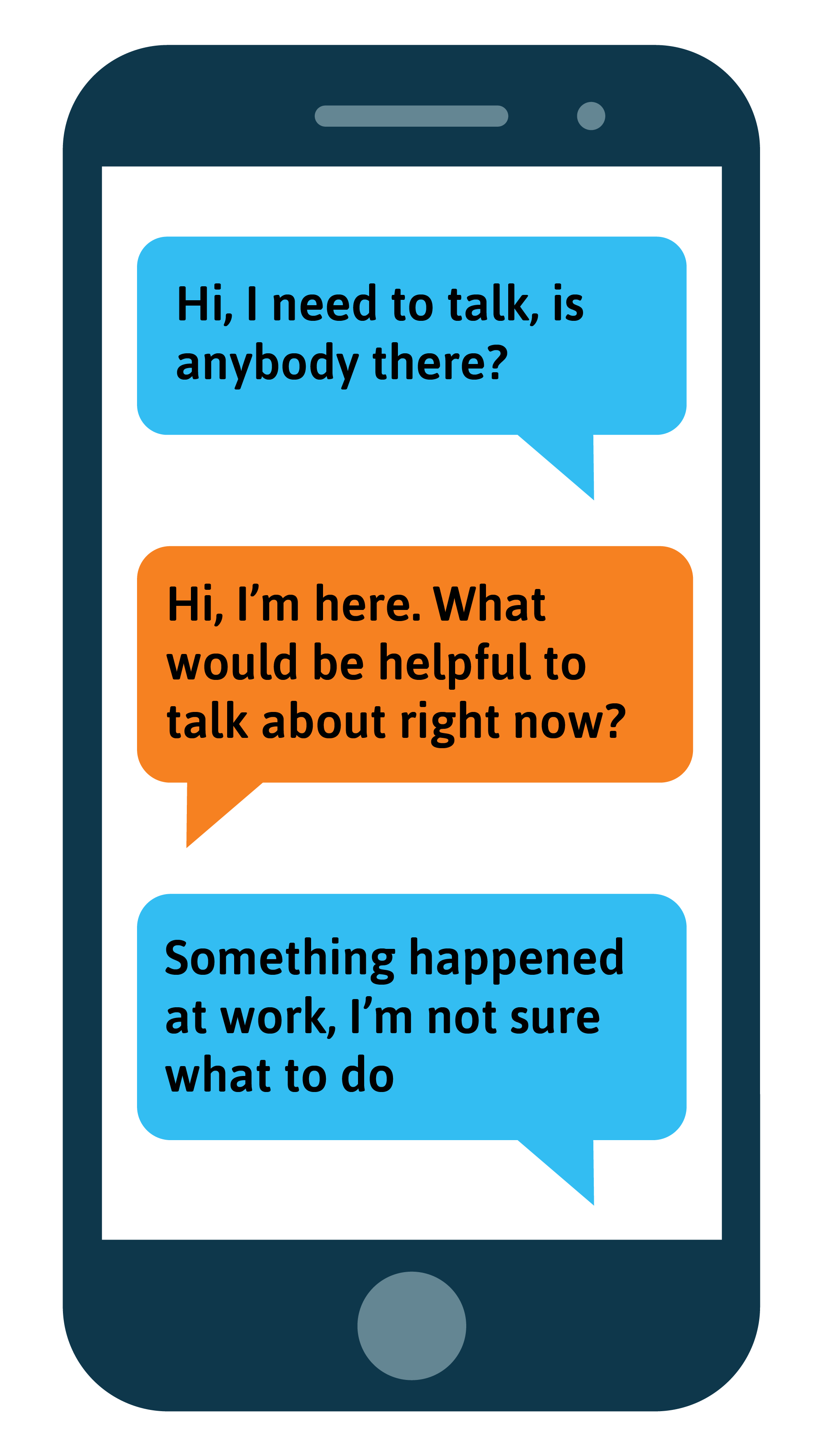
Partner organizations had unlimited access to the Empower Work peer counselor text line with a separate tracking keyword to separate each partners’ aggregate text conversations and data. When a help seeker from any partner organization texted in, they were connected with a peer counselor to begin their anonymous text conversation. Text conversations could last as long as the help seeker continued, averaging 100 minutes, and a help seeker could reach out as many times as they needed. Partner organizations reviewed aggregate data with Empower Work regularly over the course of the partnership to evaluate various outreach efforts, align on shared learnings, and generate new hypotheses.
None of these learnings would have been possible without the commitment of each of these organizations to test and learn alongside us. They approached this work with full program calendars, stretched teams, and communities counting on them. Amidst that, they made room to try something new, to be honest about what was working and what wasn't, and to keep the focus where it belongs: on ensuring the learners and workers they serve have the best possible chances of success. We are grateful for their partnership, their openness, and their willingness to prioritize the communities they serve above the comfort of the familiar. With 6 months remaining in this pilot, we are excited to put these learnings into action, and optimistic that the results will open the door to future investment.
Impact To Date: 18 Months of Findings
Engagement varied across partners, shaped by where in the user journey Empower Work was introduced, the partner's existing support infrastructure, and the cadence of communication. But for users who engaged, the impact was substantial and consistent.
Across Empower Work’s text line data, it is clear that emotional and economic well-being are inextricably intertwined. For this partnership testing, understanding the longer term economic impacts and how they were tied to confidence, agency, resilience amidst hardship, were important. While longitudinal data is still in the works, early data is promising:
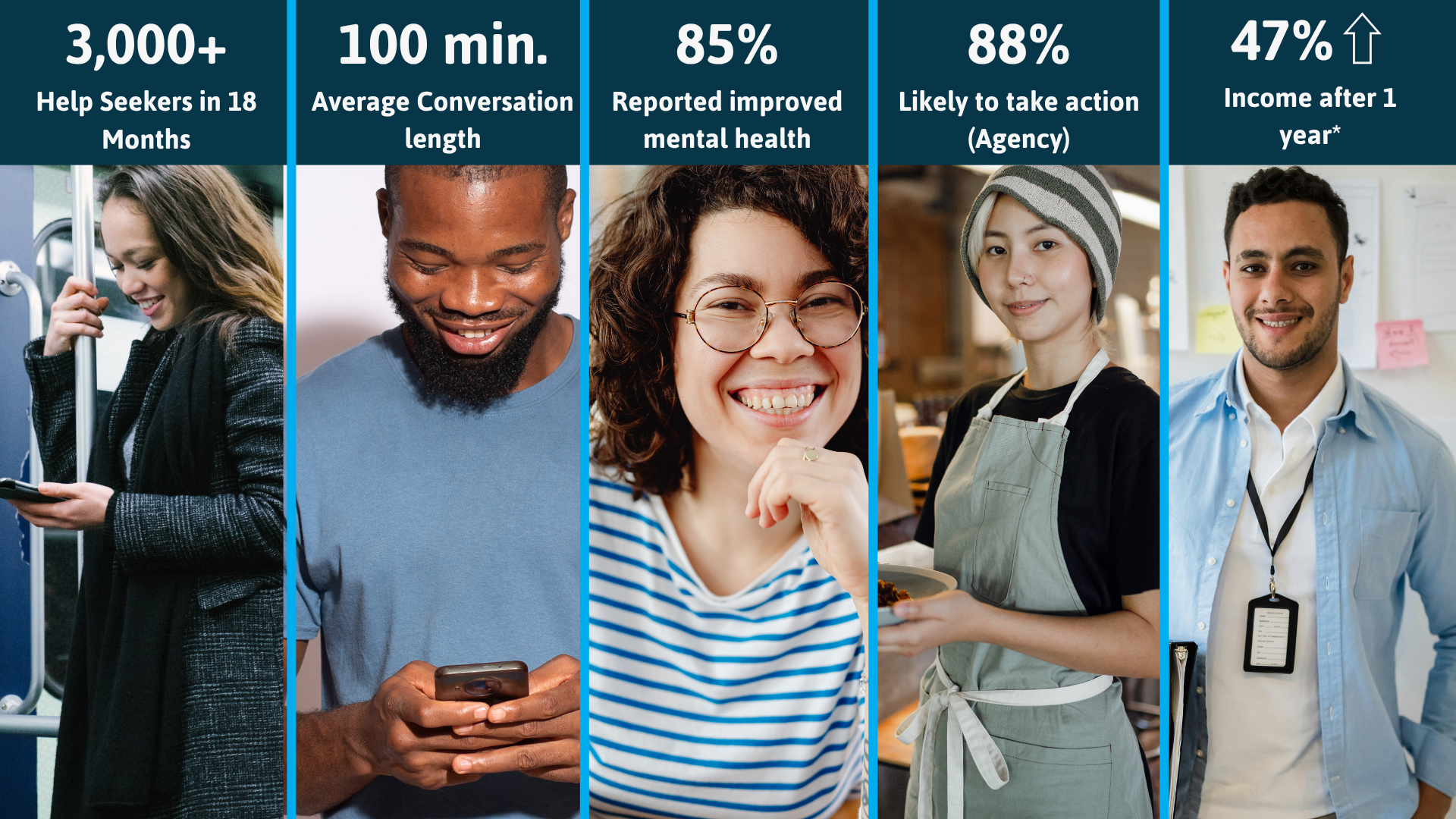
* Income after 1 year: self-reported in surveys by help seekers referred through partners.
Across all five partners, unemployment and fear of job loss were the most common reason workers reached out (50% of conversations), followed by active job search or career decision-making (23%). Beyond that shared pattern, each partner’s community surfaced distinct needs. SkillUp help seekers were actively weighing career decisions. Per Scholas learners and alumni surfaced overwhelm and imposter syndrome alongside job insecurity. Year Up United alumni engaged years after completing the program at moments of transition. NPower users showed the highest rate of workload and wellbeing needs. MAM Houston had the most distribution profile, with unemployment, job search, and workplace conflict in nearly equal measure. Across all partners, workers returned: 21% of texters came back for additional support, with conversations averaging over 100 minutes. They are sustained navigation moments, and they deserve a measurement framework that can see them.
What We Learned: Five Insights for the Field
Across this work, a clear set of operating lessons has emerged. Each finding speaks to a real pattern observed across partner contexts, and each offers practical guidance on additional testing needed to ensure workers have the support they need for maximum impact.
1. The Window Opens Earlier Than We Thought
Initial Hypothesis: Alumni and graduates were the best audience for navigational support, and a well-timed introduction would be sufficient.
What We Learned: The initial gap partners and Empower Work sought to address was insufficient support for alumni after they secured a job. But we learned that navigational support introduced at the alumni stage often comes too late, and a single touchpoint isn't enough. Ongoing navigational support is a new concept, and shifting expectations requires reinforcement across multiple channels in coordinated waves: lifecycle emails, SMS reminders, dashboard placements, and in-person mentions from instructors and coaches. Introducing the service earlier gives learners a chance to practice asking for help before harder moments arrive, so that by the time those moments do arrive, Empower Work is already familiar.
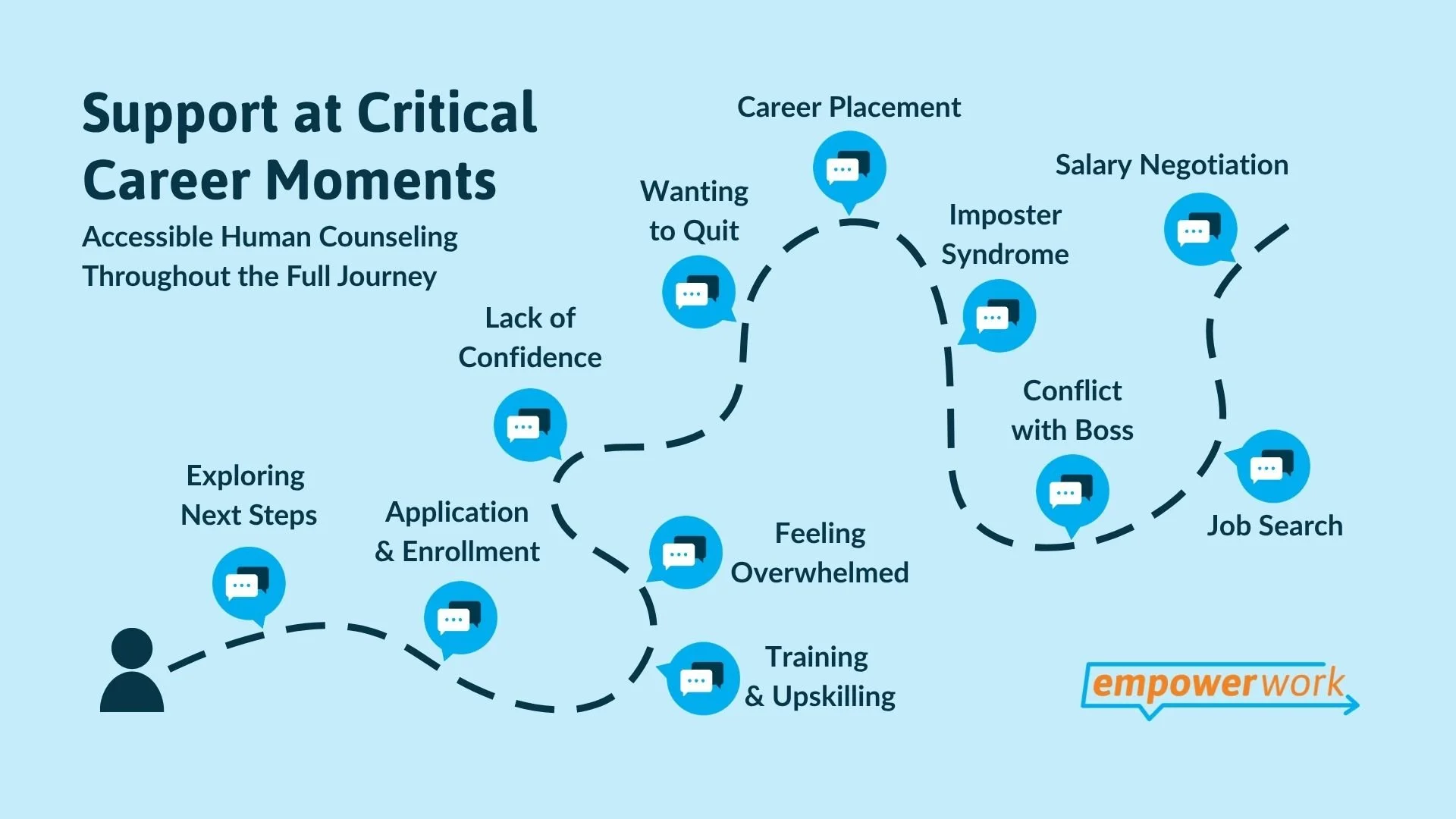
During the pilot we began to introduce Empower Work earlier and we found that the support that was needed varied based on the stage of their journey from exploring and enrolling, through training, job search, the first stretch on the job, and the disruptions and pivots that follow. Each partner reaches workers at a different point along that arc, though none is confined to a single stage. Drawing on insights from candid text conversations, our partners were able to make operational changes that better support learners at each stage of their programming. This is an example of how a posture of listening well, and responding to data in partnership, can change structures, not just treat symptoms.
Empower Work is, in effect, creating a new category. Workers have not been conditioned to expect real-time, confidential career support as something they can access and deserve. Building that expectation requires more than a single introduction. It requires enough repetition across enough touchpoints that asking for help feels expected and earned.
“Though we initially positioned Empower Work in several channels – alumni newsletter, Slack community, week 10 of our Professional Development curriculum, Learning Management System dashboard, and instructor announcement signatures – we saw in the data that there was a limited response. This made us wonder: could we introduce the helpline earlier in the Per Scholas journey, and how can we build better connections in order to scale? We appreciate how this partnership allows us to lean into our curiosity, try new ways to support our learners and alumni, and keep iterating based on the data.”
What We Are Still Testing: Through ongoing discovery work, a partner identified a stage in their learner's journey that could benefit from additional support: the point when program content shifts entirely to technical mastery and coaching support decreases. Empower Work’s navigational support has the potential to fill that space in a meaningful way. Another upcoming test is introducing Empower Work at the moment of non-acceptance, when an applicant has just been turned away, redirected, or told the program is not the right fit. That moment is pivotal; the redirected applicants are currently underserved, and the need is immediate. We have continued to introduce Empower Work at various points in a worker’s journey and work with partners to examine broader structures of support. With more operational structure built out and more Empower Work touchpoints, we see potential to meaningfully increase engagement and further demonstrate the importance of providing workers with support throughout the many twists and turns of their career journey.
“..I felt like quitting as it’s overwhelming. I can’t quit my job as I have bills and don’t want to quit as I want to advance to a different opportunity[...]I know I can finish it, I just need to get through other things slowly…I appreciate you taking your time to talk with me. It really helps.”
2. Size of Alumni Community and Adoption Timeline
Initial Hypothesis: Workforce Training Partners have 250,000 Engaged Alumni
What We Learned: The number of engaged alumni of workforce training programs is smaller than we projected. Although the pool was smaller, the conversations were substantial. Across the pilot, the average conversation length was 100 minutes. This sustained human engagement expands the capacity of career coaches who are not always available at the exact moment of need. Once we shifted communication earlier in a learner’s journey, a meaningful share of conversations came from learners still in training who felt discouraged and found a peer counselor to be the resource they needed to keep going.
“We originally thought the need for peer counseling was greatest for Per Scholas alumni, but we are now looking at the full Per Scholas journey, starting with eligibility and application checks and continuing with those who start but are not able to complete our programs. From our joint learning with Empower Work, we’re seeing new opportunities to support people in hard moments.”
What We Are Still Testing: Updated messaging so it is easier and clearer for workers to know how and when to reach out to Empower Work, ultimately enabling the depth of engagement we see once they connect to reach more of the workers who need it. This requires testing messaging and positioning at various stages as well as testing whether having learners use the text line as part of career development can build a lasting expectation that support at critical career moments is not a last resort. That it is something workers can count on and have earned.
“I really felt like the core of my issue was understood, and she cut right through my confusion with the most valuable thing anyone has told me about how to start a new business with a strong ethical stance on responsible AI.”
3. Specificity Is the Strategy
Initial Hypothesis: Shared language and materials would translate across partners and drive consistent adoption.
What We Learned: Working closely with each partner and understanding their journey was critical. A one-size-fits-all approach to language and marketing assets was not sufficient. We worked closely over time to deeply understand the journey of each partner’s constituents and tested various engagement strategies. For example, SkillUp's integration into their primary dashboard increased engagement by 80 percent, far more than email and SMS outreach alone.
“We took an iterative approach to sharing Empower Work’s text line, systematically testing each of our digital channels (SMS, email, dashboard, profile pages, webpages) with different content until we were satisfied with engagement. We had a hypothesis that personalized private text-based coaching would be valuable, but we needed to run these tests to find out who would find the service most helpful and when they would be best positioned to use it. By staying curious, we not only shared a critical service but learned many valuable insights about our own users along the way.”
Per Scholas tested introducing Empower Work in their alumni newsletter, Slack community, week 10 of the Professional Development curriculum, their Learning Management System dashboard, and instructor signatures. These additions modestly increased engagement, however the full impact may not show up in the numbers until learners have started the job search.
What We Are Still Testing: The optimal language and channel combination for each integration point and partner context. Physical presence is one area of active exploration. For partners with brick-and-mortar locations, we recently developed a suite of materials including posters, table tents, and window clings, designed to meet community members where they already are. We are now measuring the impact of those placements and exploring how this approach might extend to other partners with physical sites. Other partners, such as MAM Houston, have invited us to job fairs and food distribution events and these strategies have shown early success. The broader lesson is that no single channel strategy holds across all contexts, and the work of finding the right fit for each community is ongoing.
“Yes, I know the main objective is to help with how to move forward and what steps to take next, but I really just appreciate the understanding and validation of what I’m going through. It makes me feel sane. And I love y’all’s calm approach and demeanor in your responses.”
4. Staff Needs Clarity, Not Convincing
Initial Hypothesis: Frontline staff would welcome an additional resource for their communities and actively promote it once leadership committed to the partnership.
What We Learned: Even with strong leadership buy-in, frontline staff sometimes hesitated to promote the text line actively. In the current economic climate, where AI-driven layoffs are reshaping every sector, including workforce development itself, staff concerns about job security and unclear referral norms can quietly suppress adoption. One organization illustrated this directly: midway through year one, a move toward more centralized training and regional staff coverage created both a near-term engagement dip and a longer-term opportunity to embed Empower Work into centralized infrastructure rather than relying on a single point of contact.
This is both a coordination problem and a buy-in problem, and it underscores the importance of clear positioning and incentives. Empower Work expands what coaches can do; it does not replace them. When Empower Work’s peer counselors absorb the emotional weight of high-stress moments, the anxiety of a job search stalling, the discouragement of a difficult week in training, the uncertainty of a first role that is not going well, coaches are freed to do what they are uniquely qualified to do: sector-specific interview techniques, referrals to local community partners, and local hiring pipelines. When Empower Work holds the emotional support function, in-house career coaches can focus on the rest.
This scaffolding makes support durable. Workers do not have a single need at a single moment. They need emotional grounding when doubt sets in, sector-specific guidance when they are ready to navigate, and connection to local resources when circumstances outside work require it. The referral to Empower Work is not a handoff. It is a way of ensuring the right support shows up at the right moment.
What We Are Still Testing: Whether structural changes inside partner organizations, leaner staffing models, and more centralized delivery affect staff receptivity and referral rates, and what onboarding and ongoing support best address hesitation before it suppresses adoption. One partner recently incorporated referral goals in their internal KPIs which has the potential to increase engagement.
5. Channel Match Drives Uptake
Initial Hypothesis: Educating partner staff would be the best approach to accelerate adoption.
What We Learned. As a category creator, we had to build trust with partner staff and rely on them to convey the Empower Work value proposition alongside everything else they're required to communicate, and this did not drive adoption as quickly as we had anticipated. However, when the handoff matches the channel that workers are already using, uptake is higher, and friction is lower. When Empower Work is positioned as a link in a mobile or desktop experience, uptake is higher, and confusion is lower. The SkillUp partnership offers the proof point for digital-to-digital pathways, with dashboard integration increasing engagement by 80 percent. And MAM Houston illustrated that reaching their community through SMS was most effective.
“We have shared the Empower Work text line in many ways with the MAM Houston community, including flyers, email, website, and SMS. So far, our SMS campaigns have been the strongest drivers of text line engagement. We hypothesize that this is because people are already on their phones and ready to have a 1:1 text conversation with a counselor. But we know there is still more to learn and are eager to keep testing new ideas and content.”
Channel match also means timing. Within each partner journey, there are multiple points when someone might be feeling strong emotions and could benefit from a 1:1 conversation. For NPower alumni, frustration may peak after a few months of sustained job searching, and motivation may be at risk. For Per Scholas learners, feelings of overwhelm might rise when technical demands increase and professional development support decrease. For job seekers at Memorial Assistance Fund (MAM Houston) community job fairs, discouragement may set in after they return home and relax from putting on a confident, positive front for potential employers. Identifying those inflection points within each partner's journey and meeting workers there, rather than asking them to seek out support on their own, is what drives sustained engagement.
“Chatting with my peer counselor was a grounding experience. These last few decades have been rough, and the past few years even harder. But in that conversation, I felt heard, supported, and valued.”
What We Are Still Testing: The right channel and timing combination for each partner context, and how to build those touchpoints into partner systems as infrastructure rather than one-off communications.

What Comes Next
Deepen Integration with Existing Partners
Our original targeting model assumed reach would come primarily through alumni; the next phase shifts that assumption toward meeting workers earlier in their journey, where the evidence now points. The first phase of the pilot revealed that integration depth, not initial introduction, drives sustained engagement. Each partner is now ready to move from pilot to embedded infrastructure. That shift requires investment in technical work, training, content development, and dedicated relationship management on both sides.
The most strategically valuable touchpoints are often the ones partners themselves identify as gaps, the places where they wish they could serve their community better but cannot stretch any further. Mapping those gaps together produces integrations that feel additive rather than competitive, and positions Empower Work as a way to honor a commitment the partner has already made to their community. Each new integration point also generates learning that sharpens the model for the partners that follow.
“As we launch our new NPower Alumni Community Portal and drive long-term engagement, we are excited to share Empower Work’s personalized coaching service while deepening our understanding of alumni needs along the way. As the job market continues to evolve, we want to strategically position supportive resources so alumni can access the guidance when they need it most.”
Alignment on Impact Metrics
To date, our collaborative focus has been on integration, alignment, and adoption. As this partnership work matures, we are turning our attention to a deeper understanding of the full arc of impact Empower Work support has on workers' financial and emotional wellbeing. We now recognize that Empower Work’s support can benefit learners at many points along their journey, and building a rigorous framework to capture that additive impact is our next priority.
That is the challenge we are building toward. A worker who navigates a difficult situation and stays employed, avoids a conflict that could have derailed their career, or simply feels more grounded and capable at work does not show up in an earnings increase. Yet the financial and emotional impact of that support is real. We recognized this is more nuanced than simply the financial gains over time and requires a different model of measurement. To build this framework we intend to bring in a third-party expert in precision causal modeling to align data across all partner organizations and help us capture the outcomes that traditional metrics miss and help us tell a more complete story.
Each partner organization has contributed baseline data to this effort. Together, we will review those metrics, co-create a measurement plan tied to both the training and text line support components, and establish a regular cadence to measure, review, and learn.
Expand to New Partners and Underserved Geographies
Beyond the founding partners, sustained demand exists from workforce organizations across the country. The model is replicable, but each new partnership requires upfront investment to map the right integration points, train staff, develop joint communications, and measure impact.
We have had the opportunity to test on a small scale with the San Francisco Public Library and with local organizations in Chicago, Dallas, Los Angeles, Newark and Philadelphia, through a place-based partnership with Verizon. We are currently working alongside these agencies to seek local investment to support more robust integration. The anchor partner model is instructive here. Once a community-based organization is established as a partner, it can become a credible referral source for sister organizations in its region, creating a multiplier effect that no national outreach campaign can match. A single anchor partnership can seed broader adoption across a regional cluster of organizations serving the same workers at different points in their journey. Without dedicated funding for partnership development, replication slows to the pace of organic interest, which is too slow given the volatility ahead.
Build Incentives for Cross-Organizational Collaboration
This is the priority that requires the most candor from the field, and the most strategic patience from funders. Today, workforce organizations compete for the same pool of philanthropic and government dollars. Each maintains separate alumni systems, separate measurement frameworks, and separate brand identities. Cross-organizational collaboration, the kind workers actually need, requires investment from every partner involved, but does not show up cleanly in any single organization's outcome metrics.
Shared navigational infrastructure functions, in effect, as a coordination layer. It reduces the friction of helping workers move across organizations, programs, and life stages. But coordination layers are systematically underfunded in philanthropy because they do not fit neatly into any single grantee's reporting frame. They serve the worker, not the institution.
The investment case is therefore not for one organization. It is an ask for funders to recognize and incentivize the coordination work that a worker-centered future for this sector requires. That might take the form of consortium grants that pool resources across workforce partners, shared measurement frameworks that credit cross-organizational outcomes, and explicit funding for the connective tissue that no single training organization can build alone.

The Forward Challenge
Initial findings show promise, with some critical testing still required to determine whether the field can scale before conditions worsen. Three forces are converging.
The labor market is becoming more volatile, not less.
AI-driven workforce disruption is no longer speculative. It is reshaping entry-level white-collar work, customer service, content production, and a growing share of the IT roles that workforce training programs prepare learners to enter. Federal workforce contraction, tariff exposure across manufacturing, and continued instability in retail and hospitality compound the pressure. The pattern of sideways and reactive moves that workers already experience will only intensify. Workers will move more often, with less notice, and under greater financial strain.
Workforce organizations have fewer resources, not more.
Across the sector, alumni and learner teams are stretched. Career coaches are carrying caseloads that exceed what high-quality support requires, and many are absorbing functions, like helping clients access housing or health coverage, that fall outside their original mandate. Philanthropic and federal funding cycles have tightened. Career guidance is one of the most leveraged interventions in workforce development, and yet it remains one of the most chronically underfunded functions inside it.
“One of the clearest insights from our data is that SkillUp users are 4x more likely to engage with Empower Work than with live Zoom coaching. This underscores an important shift in user behavior: workers are increasingly looking for support that is convenient, personalized, and available in the moments they need it most. Rather than replacing traditional coaching, text-based support expands access by lowering the barriers to getting help, making it easier for workers to access career and life support.”
Workers are navigating multiple organizations, not just one.
A worker today might enter a Per Scholas program, complete training, take a first IT role, lose it 18 months later, return to SkillUp for career navigation, attempt a pivot into healthcare, and engage in a community college program for new credentials. No single workforce organization sees the full picture, and no single organization can. Yet most cross-organizational collaboration today happens informally, without infrastructure or funding, and depends on individual relationships rather than systems.
These three forces, taken together, mean that the field cannot scale the way it has historically scaled. Adding more alumni coordinators at each organization will not be enough. Building one new program in one more city will not be enough. The work ahead requires shared infrastructure that supports workers across organizations and across transitions.
2026 and Beyond: Why This Matters
The workforce ecosystem can reach far more people when scalable services are shared, and organizations are incentivized to do so.
Recent research makes the stakes clear: the ability to move through a series of decisions over a working life, gathering information, weighing options, and acting, is becoming the single most important determinant of who advances and who gets stuck. AI is accelerating that reality, not creating it. Workers cannot be expected to carry that load alone.
Our partnership work and growing demand for the text line have also sharpened how we think about measuring success. It looks different depending on where a worker enters. For someone navigating a difficult situation at work, success is staying employed with the skills to handle what comes next. For someone who just lost a job, success is shortening the path to the next one. Empower Work is building the measurement infrastructure to match: a precision causal modeling framework and analytical tools that move beyond correlation to identify which approaches drive outcomes for which workers.
Initial findings from this pilot established that real-time, human, text-based peer support is a critical part of the scaffolding workers need during a period of unprecedented volatility. But scaffolding requires a structure of support. Career navigation deserves to be treated as essential workforce infrastructure, funded and built accordingly. That is the broader call to action. Workers cannot be expected to carry the weight of a transforming labor market on their own. Their needs shift throughout their journey, and supporting them requires connective infrastructure that provides both access to vital resources and information, alongside the emotional support that critical career moments demand. The field needs new incentives for the cross-organizational collaboration that today's workers require, not just within the boundaries of any single program, but across the full arc of a career. The next twenty-four months will determine whether the field can build that infrastructure before the volatility ahead overwhelms the workers it was built to serve.
Help Seeker Testimonial - Dawn’s Story
After months of long-term unemployment, Dawn felt like she'd exhausted every option and had nowhere left to turn. That's when she found Empower Work’s service through SkillUp Coalition. Watch the video to learn about how a conversation with a peer counselor helped her regain confidence and change the trajectory of her work life.
Staying In Touch
We are grateful to Truist and GitLab for giving us the space to experiment and learn,and our five workforce partners for joining us on this learning journey. Over the final six months of this pilot, we will continue sharing findings and welcome funders and partners committed to outcomes-focused, worker-first career navigation.
To explore a partnership, a funding conversation, or a deeper dive into the data and learnings from the pilot, reach out to partnerships@empowerwork.org.